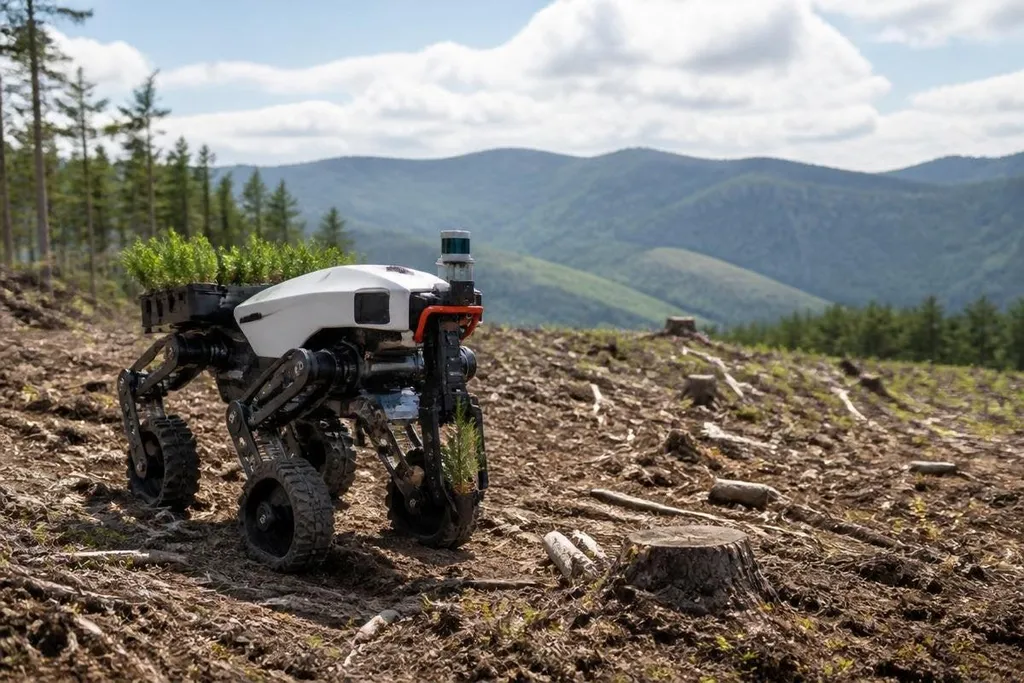
Tree-planting robots work by placing seeds or young trees into prepared ground, often across land that is hard for people and vehicles to reach. Their value depends on more than planting speed: each tree must suit the soil, survive the first dry period, and grow without harming the wider forest.
- Ground work: Sensors can read soil shape and surface conditions before planting.
- Plant choice: A robot still needs a planting plan based on local trees and weather.
- Main limit: Planting is one task; keeping seedlings alive takes years.
How the machines plant trees
A tree-planting robot usually combines a mobile base with a planting tool. The base may use wheels, tracks, or legs to cross rough ground, while cameras and other sensors help it avoid rocks, steep drops, and fallen branches.
The planting tool opens a small hole, places a seed or seedling, and closes the soil around it. That order matters. Loose soil can leave roots exposed, while packed soil can block water and air from reaching them.
Some systems can work from a digital map. The map may mark planting zones, slopes, access routes, and areas that should remain untouched. This lets the robot place trees where the plan calls for them instead of spreading seedlings across the whole site.
Where robots make sense
Large burned areas, steep hillsides, and remote sites can make manual planting slow and costly. A robot can repeat the same planting motion for long periods, while a crew handles transport, checks, repairs, and follow-up work.
The machine also gives forest managers a record of what happened.
A planting log can show where each seed or seedling went, when the work took place, and which areas still need attention. That record matters when teams return to check survival.
For a forest manager, the useful question is whether a planting robot’s map connects each tree to survival checks months later. Robot 24 can place the machine, planting method, test site, and follow-up record beside the maker’s result, giving the next section a way to judge ground damage as well as planting speed.
Robots may also reduce the need to send heavy vehicles across fragile ground. That can help limit soil damage, though the robot itself still adds weight and may struggle on wet or deeply rutted land.
Planting does not equal forest recovery
A machine can place a seed in the ground. It cannot control rainfall, grazing animals, insects, fire, or competing plants. Those factors can decide whether a planted area becomes a forest or an empty patch with dead seedlings.
The choice of tree matters too. A planting plan should match local species, soil, water, slope, and nearby habitat. A fast-growing tree may look useful on paper but create problems if it does not belong in that forest or needs more water than the site can supply.
Human work remains part of the process. Crews may need to clear a safe route, load seedlings, inspect planting depth, repair the robot, and replace trees that fail. The machine handles repeated placement; people still make many of the decisions around it.
The strongest claim for these robots is narrow: they can help put more trees into difficult places. Claims about faster forest recovery need long records that compare survival, soil damage, labor cost, and water use against manual planting.
A practical check before buying or deploying one
Use this checklist when comparing a robot for a real restoration site:
- Map the ground: record slopes, rocks, wet areas, access routes, and protected zones.
- Name the planting target: decide whether the machine handles seeds, bare-root trees, or container seedlings.
- Check the tool: confirm planting depth, spacing control, refill time, and how the system handles blocked holes.
- Plan the people: assign staff for transport, repairs, safety checks, and survival surveys.
- Measure the result: count live trees after the first dry season, then repeat the check later.
- Price the full job: include transport, charging, software, repairs, seedlings, and follow-up visits.
I'd skip a robot whose maker reports planting speed but gives no survival data from outdoor work. The useful measure is the number of living trees after the first difficult season, not the number placed in the soil on day one.
That is where the next proof must come from: repeated field records showing which planting methods leave a forest with more living trees after one year, five years, and longer.